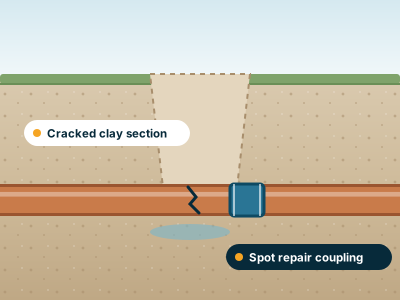
What is sewer line repair?
Sewer line repair fixes a damaged section of the building sewer, the lateral that carries everything from the house to the public sewer main, without replacing the entire run. The damage might be a cracked clay tile, a joint that has pulled apart, a section crushed by soil movement, or a stretch packed with roots that have broken through.
In Zanesville, the City says it is responsible for the sewer main, and homeowners are responsible for problems with the lateral that extends to the home. That makes the lateral one of the more expensive pieces of plumbing an owner can be responsible for, and one of the least visible. Most of it is buried under the lawn, the sidewalk or the driveway.
A repair is targeted: it starts with locating the problem precisely, usually with a sewer camera inspection that measures the distance from the cleanout to the damage. With that number, the repair can be made in one place instead of trenching the whole yard.
How are sewer lines repaired?
The right repair depends on what failed, how deep it is and what sits on top of it.
Point repair by excavation
A pit is dug over the damaged spot, the bad section is cut out, and a new piece of pipe is joined in with shielded couplings rated for the job. It is the most direct fix for a single break, especially where the line is shallow and the ground above is lawn.
Spot lining (sectional liner)
A short resin-saturated sleeve is pulled into position and inflated against the pipe wall, where it cures into a new pipe inside the old one. It seals cracks and root entry points at a joint without digging, if the pipe still holds its shape.
Root removal and joint sealing
When roots are the main problem but the pipe is intact, the line is cut clean and then sealed at the entry points, often with a spot liner. Cutting alone is maintenance, not a repair, because roots return to the same gap.
When repair is not enough
If the camera shows many failed joints, long sags or a collapsing section, patching one spot just moves the next backup a few feet down the line. That is when sewer line replacement or trenchless lining of the full run is the better value.
8 signs your sewer lateral may need repair
- Root clogs that return within a year of the main being cleaned.
- Water or sewage at the basement floor drain after heavy rain or a load of laundry.
- A soggy, sunken or unusually green strip in the yard along the path of the line.
- Sewer odor outside near the foundation or over the line.
- Several fixtures gurgling or draining slowly at the same time.
- Cockroaches or rodents appearing in the basement with no other obvious entry.
- Cracks or settling in a sidewalk or slab directly over the pipe route.
- Camera footage from an earlier cleaning that showed a crack, offset joint or sag.
Root clogs that keep coming back? Talk to a local provider about repair options.
Why sewer laterals fail in Zanesville
Three things wear out laterals: the material they are made of, what grows and moves around them, and how long they have been in the ground. Zanesville scores high on the last one. Census estimates put about four in ten homes in the city as built in 1939 or earlier.
- Clay tile joints. Clay pipe itself lasts a long time, but it was laid in short lengths with mortar or early gasket joints. Those joints loosen, let roots in and shift out of line.
- Cast iron corrosion. Cast iron scales and thins from the inside. Eventually the bottom of the pipe can split along its length.
- Orangeburg pipe. Fiber pipe used in some mid-century construction softens and flattens under soil load.
- Freeze and thaw. Ohio winters move shallow soil, and a pipe with a weak joint feels it.
- Heavy loads. Driveways, parking pads and construction equipment over a shallow line can crack it.
- Past repairs. A mismatched coupling or an unsupported patch from decades ago can become the next failure point.
Spot repair or full fix: what the footage tells you
The same footage that locates a break also shows what the rest of the line looks like. If the camera passes through clean, round pipe on both sides of one bad joint, a point repair or sectional liner is usually the sensible choice. If it shows roots at every joint, a sag holding water and cracks along the run, fixing one spot leaves the next failure a few feet away. Ask the provider to talk through the whole video, not just the worst moment.
What you can safely check first
You cannot see a buried pipe, but you can gather the facts that make a repair estimate accurate.
- Locate the cleanout and check whether water is standing in it when you lift the cap carefully. Standing water means a blockage downstream.
- Walk the line. Look for soft ground, depressions or lush grass between the house and the street.
- Note the timing. Backups that follow rain point to a different problem than backups that follow laundry day.
- Find old paperwork. Inspection reports, past camera videos or receipts tell the provider what is already known.
Root clogs that keep coming back? Talk to a local provider about repair options.
What a sewer repair visit looks like
- Clear the line. The main is cleaned so the camera can see the pipe wall.
- Camera inspection. The footage identifies the damage, and a locator on the surface marks its position and depth.
- Options and price. You hear which repair fits, why, and what it will involve on your property.
- Utility locates and permits. Before digging, buried utilities must be marked through Ohio's 811 system, and the provider should confirm any city permit the work requires.
- The repair. The pit is dug or the liner installed, and the new section is connected.
- Verify. A second camera pass or a flow test confirms the repair.
- Restore. The pit is backfilled and compacted; ask what restoration of lawn or pavement is included.
What affects the cost of a sewer repair?
Repair pricing depends heavily on what is above and around the pipe. Ask how each of these applies to your property.
| Factor | Effect on the job |
|---|---|
| Depth of the pipe | Deeper lines mean bigger pits and more shoring. |
| Surface over the break | Lawn is simple; concrete, asphalt or landscaping adds restoration. |
| Repair method | Excavation, spot lining and joint sealing are priced differently. |
| Number of defects | One break is a point repair; several may change the recommendation. |
| Permits and inspection | Any required city permit or inspection adds time and fees. |
When a sewer problem is an emergency
Call right away if raw sewage is coming into the basement, if no fixture in the house will drain, or if a hole opens in the yard over the line. Stop using water to limit what comes back up. If the backup seems to come from the city side, the City of Zanesville recommends calling its Wastewater Plant first. Our emergency drain page has the first steps.
Sewer Line Repair FAQs for Zanesville homeowners
Is the sewer lateral the city's job or mine in Zanesville?
The City of Zanesville says it maintains the sewer main, and homeowners are responsible for the lateral pipe that runs to the home. If you are unsure which side a problem is on, call the city's Wastewater Plant before calling a plumber.
Can a sewer line be repaired without digging up the yard?
Often, yes. Spot liners can seal a crack or a leaking joint from inside the pipe, and full-length trenchless methods can rebuild the whole line through small access pits. They need a pipe that still holds its shape.
How do I know whether to repair or replace?
Look at how many problems the camera found. One break in an otherwise sound line usually calls for a repair. Many failed joints, long sags or a collapsing section usually make replacement or full lining the better long-term value.
Does homeowners insurance cover sewer line repair?
Many standard policies exclude wear and tear on the pipe itself, and some offer optional service line or sewer backup coverage. Check your policy and ask your agent before work starts.
How long does a point repair take?
Many single-spot repairs are completed in a day once utilities are marked, though deeper lines, paving and permits can extend the timeline. Ask the provider for an estimate after the camera inspection.
Will roots come back after a repair?
Roots return to gaps. A repair that replaces or seals the damaged joint removes the gap, so roots in that spot should not return. Other untreated joints on the line can still let them in elsewhere.
Related services and areas
Lateral repairs are common in the older housing of Putnam and central Zanesville, and in South Zanesville where many homes predate 1980. For a general picture of clogs before a repair, see drain cleaning in Zanesville, OH.