What is trenchless sewer repair?
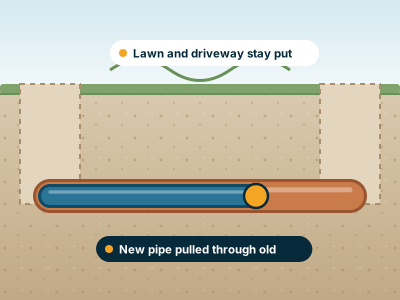
Trenchless sewer repair rebuilds or replaces an underground sewer line using one or two small access points instead of digging a trench along its full length. The two main methods are cured-in-place pipe lining, which creates a new pipe inside the old one, and pipe bursting, which pulls a new pipe through while breaking the old one apart.
Both methods solve the same problem as open-trench sewer replacement: a lateral that has failed in too many places to patch. The difference is what happens to the surface. On properties where the line runs under a driveway, a porch, a mature tree or landscaping, the savings on restoration can be significant.
Trenchless methods are not right for every line. They depend on the shape, condition and route of the existing pipe, which is why a camera inspection is the first step. For context on the clogs that usually lead here, see our page on drain cleaning in Zanesville, OH.
How trenchless methods work
Cured-in-place pipe (CIPP) lining
The line is cleaned and inspected. A flexible felt or fiberglass tube saturated with resin is pulled or inverted into the old pipe and inflated against its walls. Heat, steam, hot water or UV light cures the resin into a hard, jointless pipe. Lateral connections are reopened from inside.
Pipe bursting
An access pit is dug at each end. A cone-shaped bursting head is pulled through the old line, fracturing it outward, while a new HDPE pipe follows behind. The new pipe can be the same size or larger than the old one.
Sectional liners
Short liners fix one problem area, such as a cracked joint, and are often used as a targeted sewer line repair.
Choosing between them
Lining needs a pipe that still holds its shape and has no severe sags. Bursting can handle more damaged pipe but needs a fairly straight route and room for pits. Neither corrects a deep belly, which may require open excavation of that section.
8 signs your line may be a good fit for trenchless
- The line runs under a driveway, walk, patio or porch.
- A mature tree or established landscaping sits over the route.
- Camera footage shows cracks and root entry but the pipe still holds its round shape.
- The route is mostly straight from the house to the street.
- Multiple joints have failed, making spot repairs a poor value.
- The line is cast iron with scale that can be removed for lining.
- You want to avoid long disruption to the yard and access to the house.
- There are no long sags holding standing water in the line.
Want to fix the line without trenching the yard? Ask a local provider about trenchless options.
Why trenchless suits many Zanesville properties
Older neighborhoods often have exactly the conditions that make trenching expensive.
- Mature street and yard trees whose roots both damaged the pipe and would be damaged by a trench.
- Retaining walls, steps and steep lots on Zanesville's hillsides, where open digging is harder.
- Driveways and garages added decades after the line was laid.
- Brick walks and historic features in places like Putnam that owners want to keep intact.
- Clay tile with many joints, which a jointless liner or continuous HDPE pipe replaces in one pass.
What happens on the surface during trenchless work
Homeowners often picture no digging at all. The reality is less digging, in fewer places, which is still a large difference on a finished lot.
For lining, the work usually happens through an existing cleanout or a small opening near the house, with equipment parked at the curb or in the driveway. The liner is prepared on site, inserted and cured, and the line is reconnected. Most of the yard is never touched.
For bursting, expect one pit near the house and another near the street or the connection to the main, each a few feet across. Equipment sits beside the pits, and the new pipe is fused into one length on the surface before it is pulled through. Afterward the pits are backfilled and the lawn above them is restored.
In both cases the house may be without drainage for part of a day while the old line is out of service. Ask the provider for the timeline so you can plan showers, laundry and dishes around it. On Zanesville's hillside lots, ask where equipment will stand and whether access is limited, since that can affect which method is practical.
What to check before choosing trenchless
- See the camera video and ask whether the pipe is round enough to line.
- Ask about sags. A liner follows the old pipe, so it will follow a belly too.
- Ask where the pits will go for bursting, and what will be disturbed there.
- Confirm how connections are handled, at the house and at the city main.
- Ask about the warranty the provider offers on the liner or new pipe.
Want to fix the line without trenching the yard? Ask a local provider about trenchless options.
What a trenchless project looks like
- Clean and inspect. The line is cleaned, often jetted, and recorded with a camera.
- Measure and plan. Length, diameter, bends and connections are measured.
- Locates and permits. Utilities are marked and any permit is arranged.
- Access. A cleanout is used or small pits are dug at the ends.
- Install. The liner is inserted and cured, or the new pipe is pulled through.
- Reconnect and inspect. Connections are restored and a camera confirms the result.
- Close up. Pits are backfilled and surfaces restored.
Lining, bursting or open trench: how they compare
Each method has a place. The camera footage and your property decide which one fits.
| Pipe lining (CIPP) | Pipe bursting | Open trench | |
|---|---|---|---|
| Digging | Often none beyond existing access | Two small pits | Trench along the route |
| Old pipe | Stays in place as a host | Broken apart in place | Removed |
| Pipe size after | Slightly smaller | Same or larger | Any size |
| Fixes sags | No | Partly, depending on soil | Yes |
| Best when | Pipe is cracked but round | Pipe is badly damaged, route is straight | Line is shallow and under open lawn, or sags must be corrected |
| Surface disruption | Minimal | Limited to pits | Most |
On many older Zanesville lots the decision comes down to what is above the pipe. A clay line under a long driveway and a mature maple is a strong trenchless candidate. A short, shallow line under open grass with a sag in the middle may be simpler to dig and replace. A provider who offers more than one method can usually explain the trade-offs most clearly.
Whatever the method, insist on before and after camera footage. It is the only way to see that a liner cured properly, that connections were reopened cleanly and that a burst pipe was pulled the full distance.
What affects the cost of trenchless repair?
Trenchless pricing depends on the line and the method. Ask how these apply.
| Factor | Effect on the job |
|---|---|
| Method | Lining and bursting use different equipment and materials. |
| Length and diameter | Longer and larger lines need more liner or pipe. |
| Pipe condition | Heavy roots or scale need more cleaning before lining. |
| Bends and connections | Each bend or branch adds complexity. |
| Access pits | Bursting needs pits; their location affects restoration. |
When trenchless is not the right first move
If the line has collapsed and sewage is backing up, the immediate need is restoring flow, which may mean clearing or an emergency spot repair before any trenchless work is planned. Stop using water and call. The emergency drain service page explains what to do first.
Trenchless Sewer Repair FAQs for Zanesville homeowners
How long does a pipe liner last?
Manufacturers and installers generally expect cured-in-place liners to last for decades when installed correctly. Ask the provider what warranty applies to your project.
Does lining make my pipe smaller?
Slightly. The liner adds a thin wall inside the old pipe. Because the new surface is smooth and jointless, flow is usually as good or better than in a rough old pipe.
Can trenchless fix a sagging sewer line?
Not by itself. A liner follows the existing pipe, including any belly. Sags usually need open excavation of that section, sometimes combined with trenchless work for the rest of the line.
Is pipe bursting safe near my foundation?
Bursting is planned around nearby structures and utilities. The provider should assess clearances and depth before recommending it.
Will roots grow back into a lined pipe?
A properly installed liner has no joints for roots to enter along its length, which is one of its main benefits on clay lines.
Is trenchless allowed in Zanesville?
Trenchless methods are widely used for sewer laterals. The provider should confirm any city permit or inspection requirements for your connection.
Related services and areas
Trenchless options are popular where yards and walks are worth preserving, such as the brick-lined streets of Putnam and hillside lots in the East End. See all service areas.