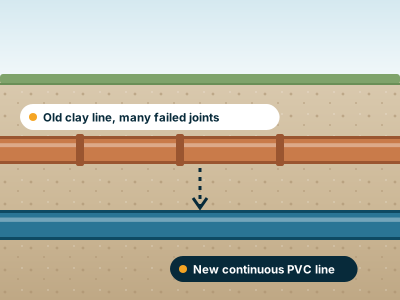
What is sewer line replacement?
Sewer line replacement removes or abandons the old building sewer and installs a new pipe from the house to the connection at the city main. Instead of fixing the worst joint, it addresses the whole run at once, so the next weak spot never gets the chance to fail.
Most replacement lines today are PVC or HDPE, smooth inside and joined with gasketed or fused connections that roots cannot easily penetrate. Compared with the clay tile or cast iron found under many older Zanesville homes, the new line has far fewer joints and nothing to corrode.
Replacement is a bigger project than a sewer line repair, so the decision should rest on clear evidence. Camera footage of the full line, from the house to the main, is the usual basis. For background on what tends to fail in the city's housing, the Zanesville drain and sewer guide is a good starting point.
How sewer lines are replaced
Open-trench replacement
A trench is dug along the route of the old pipe, the old line is removed, and the new pipe is laid on bedding at the correct slope, then backfilled in layers. It is straightforward and lets the installer correct sags and grade problems along the whole length. The trade-off is disruption to whatever sits on top.
Pipe bursting
A bursting head is pulled through the old pipe from one access pit to another, breaking it outward while a new HDPE pipe follows behind. It needs two pits instead of a trench and works well where the route is roughly straight. Our trenchless sewer repair guide covers it in detail.
Full-length lining
A resin liner the length of the line is cured inside the old pipe, creating a new jointless pipe within it. It suits lines that are cracked or root-infiltrated but not collapsed or badly sagged.
Connection at the main and the house
Every method ends at two connections: the tap at the city sewer main and the point where the line enters the house. Those are where permits, inspections and coordination with the city most often come in, so ask who handles them.
8 signs it is time to replace rather than repair
- Camera footage shows defects at many joints along the line, not just one.
- The line has been repaired before and has failed again in a new spot.
- Long bellies or sags hold standing water and waste in the pipe.
- The pipe is Orangeburg or another material known to deform with age.
- Cast iron is split along the bottom or has holes where the wall has corroded through.
- Root clogs return within months even after cutting and treatment.
- Part of the line has collapsed and a camera or cable cannot pass.
- You are renovating or adding a bathroom and the old line is already marginal.
Tired of repeat sewer backups? Ask a local provider whether replacement makes sense.
Why so many Zanesville sewer lines reach the end of their life
Zanesville grew fast in the first half of the twentieth century and peaked at about 40,500 residents around 1950, well above today's population of roughly 24,800. Much of the housing from that period is still standing, and many homes still drain through the lateral installed when they were built.
- Age. A clay or cast iron line laid before 1940 has spent more than 80 years underground.
- Many short joints. Clay tile came in short sections; a 60-foot run can have a dozen or more joints, each a potential root entry.
- Mature trees. Street and yard trees planted when the neighborhood was new are now large, with roots that reach the line.
- Ground movement. Frost cycles and settling over decades push joints out of alignment and create sags.
- Additions over the line. Driveways, garages and patios built later sit on pipe that was not designed for the load.
Planning a replacement around an older Zanesville lot
Older lots bring their own planning questions. Many homes sit close to the street with the lateral running under a front yard, a walk or steps. Others have long rear setbacks, garages or additions built over the original route. Before choosing a method, ask the provider to trace and mark the full route so everyone knows what sits on top of it.
Trees deserve special attention. The same mature trees that sent roots into the old line can be harmed by a trench cut through their root zone. That is one of the most common reasons owners choose trenchless replacement instead.
Before you agree to a replacement
Replacement is a major decision. A few steps make sure it is the right one.
- Ask for the full camera video, not just a description, and the footage distances for each defect.
- Ask why repair or lining will not work on your line specifically.
- Find out what will be disturbed: lawn, walks, driveway, landscaping, a tree.
- Clarify restoration. Is backfill, seeding or paving included, or is that separate?
- Confirm permits and inspection and who arranges them.
Tired of repeat sewer backups? Ask a local provider whether replacement makes sense.
What a replacement project involves, step by step
- Inspection and measurement. The camera records the full line and a locator traces its route and depth.
- Proposal. You receive the method, the route, the scope of restoration and the price in writing.
- Permits and locates. Required permits are pulled and buried utilities are marked.
- Excavation or access pits. The trench or pits are opened, with attention to nearby trees and utilities.
- New pipe installed. The line is laid or pulled, set at the correct slope and connected at both ends.
- Inspection and test. A camera pass or required city inspection confirms the work.
- Backfill and restoration. The ground is compacted and the agreed surfaces are restored.
Repair or replace? A quick comparison
| Situation | Usually points to |
|---|---|
| One crack or root entry in an otherwise sound line | Spot repair or sectional liner |
| Several failed joints spread along the run | Full lining or replacement |
| Long sag holding water | Excavation of that section, possibly replacement |
| Orangeburg or badly corroded cast iron | Replacement |
| Collapsed section | Excavation at the collapse, then repair or replacement |
The camera decides which row you are in. If two providers disagree, compare their footage and distances rather than their conclusions.
What affects the cost of sewer line replacement?
Replacement is priced per project. These are the factors that change it most.
| Factor | Effect on the job |
|---|---|
| Length of the line | A long setback from the street means more pipe and more digging. |
| Depth and soil | Deep lines and rocky or wet ground take longer and may need shoring. |
| Method | Open trench, bursting and lining each have different costs and disruption. |
| What is on top | Driveways, walks and landscaping add restoration work. |
| Connection work | Work at the city main or inside the basement can add steps and permits. |
Is a failing sewer line ever an emergency?
Yes, when it fails completely. A collapsed section can stop all drainage, sending sewage back into the basement within hours of normal use. If nothing in the house drains, stop using water and call. A temporary clearing can sometimes restore flow while a replacement is planned. The emergency drain service page explains what to do first.
Sewer Line Replacement FAQs for Zanesville homeowners
How long does a sewer line last?
It depends on the material and conditions. Clay pipe itself can last a very long time, but its joints often fail far sooner. Cast iron typically corrodes over several decades. Modern PVC and HDPE are expected to last much longer when installed correctly.
Can I stay in my house during a replacement?
Usually yes, though you may have no drainage for part of a day while the old and new lines are switched over. Ask the provider about the timing so you can plan around it.
Is trenchless replacement always cheaper?
Not always. Trenchless methods save restoration costs when the line runs under a driveway, mature landscaping or a long lawn. For a short, shallow line under open grass, open trench can be competitive.
Does a replacement include the connection to the city main?
It should be stated in the proposal. The connection at the main and any work in the right of way are where permits and city coordination usually apply, so ask exactly what is included.
Will I need a permit in Zanesville?
Sewer connection work generally involves the city. The City of Zanesville's Engineering Department handles sewer connections, and the provider should confirm and arrange any permit or inspection the job requires.
What pipe material is used for new sewer lines?
PVC and HDPE are the most common. PVC is typical for open-trench installs; HDPE is used for pipe bursting because it is fused into one continuous length that can be pulled through the ground.
Related services and areas
Replacement questions come up most in the oldest housing, including Putnam's Victorian-era homes and central Zanesville, and in parts of the East End. See all service areas.